Living in the Valley of the Sun comes with a unique holiday decorating challenge. While the rest of the country worries about snow and freezing temperatures, Phoenix residents face intense UV radiation, brutal afternoon heat (even in December), and monsoon dust that can damage outdoor equipment. If you’re looking for solar christmas lights for phoenix heat, you probably know that standard cheap sets won’t survive a single summer, let alone a holiday season. The good news is that you don’t have to give up on the magic of outdoor holiday lighting—you just need to choose gear designed for extreme conditions. This guide breaks down exactly what to look for, what to avoid, and how to install your lights so they shine bright through December and beyond.
Key Takeaways
- Standard solar panels degrade quickly in Phoenix; always choose panels with high-temperature tolerance and a glass or tempered coating rather than thin plastic.
- Battery chemistry matters more than capacity. Lithium Iron Phosphate (LiFePO4) or high-grade Li-ion batteries handle 115°F days significantly better than NiMH or alkaline cells.
- Water resistance ratings alone don’t protect against UV degradation. Look for UV-stabilized housings and wiring rated for outdoor continuous sunlight exposure.
- Orientation and placement are critical in the desert—panels should face south or southwest and be elevated to avoid dust accumulation and radiant heat from roof tiles.
- Versatile string designs with removable batteries and replaceable bulbs save money in the long run because they allow you to swap parts rather than replace the entire set.
Why Phoenix Heat Destroys Regular Solar Lights
The average high in Phoenix during December is still around 65°F, which seems harmless. However, solar lights sit on rooftops or in yards where surface temperatures routinely reach 150°F or more when direct sunlight hits them. That level of heat does three specific types of damage.
First, it accelerates battery degradation. Most budget solar lights use NiMH (nickel-metal hydride) batteries. At temperatures above 95°F, NiMH batteries lose capacity quickly and can permanently fail after just a few hot days. Second, the UV rays break down the polymer resins used in cheaper plastic housings. You’ll notice discoloration, brittleness, and cracks after roughly 30 days of intense Phoenix sun. Third, the LED chips themselves can overheat. While LEDs generate little heat compared to older bulbs, they still have a maximum junction temperature—and keeping them inside a sealed dark plastic tube on a hot roof can push them past their limits, causing dimming and color shift.
So when you shop, you’re not just looking for “solar-powered.” You’re looking for gear engineered for desert performance. That changes everything from the battery chemistry to the wire insulation.
What to Look For: Desert-Ready Component Checklist
Solar Panel Quality
Not all photovoltaic panels are built equal. Monocrystalline silicon panels are more efficient than polycrystalline, which means they produce the same power with less surface area. That matters in the desert because smaller panels can be placed in partial shade while still charging effectively. More importantly, look for a panel that has a tempered glass or epoxy coating rather than just a thin plastic film. Plastic panels become yellow and cloudy in Arizona sunlight, reducing charging efficiency by up to 40% within a year. The panel’s rated operating temperature also matters. Standard panels are rated to operate at up to 185°F, but quality panels maintain efficiency better at high temperatures. Any reputable desert-rated panel should list a temperature coefficient—lower is better. Aim for -0.35%/°C or better.
Battery Chemistry and Capacity
The battery is the heart of any solar light, and in Phoenix, it takes the hardest beating. Budget lights often use 1.2V NiMH AA or AAA batteries inside a sealed compartment. These will not last. Instead, look for lights that use either 18650 lithium-ion cells or LiFePO4 batteries. These chemistries tolerate higher operating temperatures and have significantly longer cycle lives. A 18650 cell rated at 2000mAh will provide roughly 6–8 hours of illumination from a full charge—enough to cover winter nights in Arizona, which can last up to 14 hours. Also, pay attention to battery placement. In better designs, the battery is removable or housed in a ventilated compartment rather than completely sealed in a plastic bubble. Ventilation allows heat to escape and extends battery life by a significant margin.
Water and Dust Resistance
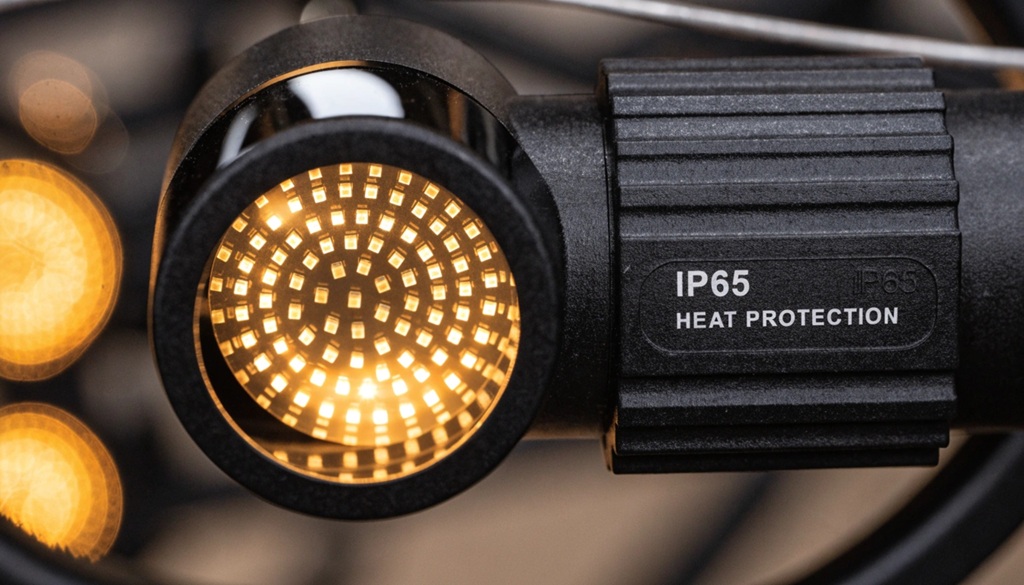
Phoenix is dry, but we get monsoon storms in July and August, and you’ll likely leave your holiday lights up through some rain in December. An IP65 rating is the minimum you should accept. IP65 means the light is protected against dust ingress and low-pressure water jets. But note that IP ratings don’t tell you anything about UV resistance. A light can be fully waterproof and still disintegrate in the Arizona sun. So check the material composition. Housings made from ABS plastic with added UV stabilizers hold up well. Avoid lights made from PVC or polycarbonate that don’t explicitly state UV resistance—they’ll turn brittle and crack within 12 months.
Understanding Light Output and Color Temperature
Lumens vs. Watts
When comparing strands, ignore wattage entirely. Solar lights consume whatever the battery provides. Instead, focus on lumens—the actual measure of visible light output. For accent lighting on palm trees or rooflines, 20 to 50 lumens per bulb is plenty. For security or path lighting, you’ll want 80 to 150 lumens. However, keep in mind that in Phoenix, ambient light from city glow and nearby shopping centers is significant. If you live in downtown or midtown, you may find that lower-lumen lights look washed out. In brighter urban settings, opt for the higher end of the range.
Warm White vs. Cool White
Color temperature isn’t just an aesthetic choice; it impacts perceived brightness. Warm white (2700K–3000K) looks softer and more traditional—think classic holiday decorations. Cool white (5000K–6500K) appears crisp and bright but can feel harsh in the desert landscape, which tends to have neutral or warm tones. In Arizona, warm white actually tends to look brighter against stucco and sandstone-colored homes, while cool white often appears washed out. However, cool white is better for highlighting greenery or cacti in the yard because it provides better contrast.
Comparing String Light Types for Desert Use
| Type | Best Use Case | Heat Considerations | Typical Lifespan in Phoenix |
|---|---|---|---|
| Copper wire fairy lights | Wrapping trees, railings, or bushes | Copper wire dissipates heat well; plastic insulation may degrade | 2–3 years |
| Silicone tube LED lights | Rooflines, gutters, patio cover edges | Silicone handles UV and heat much better than PVC | 3–5 years |
| C9-style bistro bulbs | Patio, pergola, or large trees | Larger housings retain heat; stick with vented designs | 2–4 years |
| Flat panel path markers | Walkway, driveway edges | Prone to dust settling on the panel; check tiltability | 1–2 years |
Optimizing Solar Panel Placement for Desert Sunlight
Even premium solar fixtures will underperform if their panels fail to capture Phoenix’s distinct winter sun angle. Because the sun sits lower in the southern sky during December, flat-mounted solar components often lose up to 40% of their energy potential compared to angled, position-adjustable models. Achieving reliable all-night illumination in extreme desert climates requires mounting panels at an optimized tilt toward the south, ensuring maximum exposure despite shortened winter days. Integrating updated hardware—such as high-efficiency cells designed to handle severe heat retention—complements these position adjustments for maximum power delivery. Staying ahead of overall industry updates like Solar energy trends for 2025 will also help you select panels with superior heat tolerance ratings and advanced battery technology built to withstand harsh desert environments year-round.
Orientation and Angle
Panels should face true south, not magnetic south. The difference in Phoenix is about 11 degrees east. If you’re using a handheld compass, adjust accordingly. For winter use, a fixed tilt angle of 50 to 60 degrees from horizontal optimizes solar gain. In summer, that angle is too steep, but since you’re running these during the holidays when daylight is shorter, optimizing for December makes sense.
Elevation Matters
The higher your panel is off the ground, the better. Ground-level panels in Phoenix get coated with dust within days—we have some of the highest particulate matter levels in the country during dry spells. Mount panels at least 5 to 6 feet up, where wind keeps them cleaner. Also, avoid placing panels on dark asphalt shingle roofs. A dark roof absorbs heat and radiates it upward, warming the panel significantly and reducing its output. If you can, mount the panel on a separate stake in the yard or on a white-painted fence rather than directly on the roof.
Cleaning Schedule
Plan to wipe your panels clean every two weeks from November through January. A dry microfiber cloth works fine—no water needed unless there’s caked-on dust. If you have hard water, avoid using it to clean the panels; mineral deposits will leave a film that blocks sunlight.
Common Phoenix Mistakes to Avoid
Even smart shoppers make these errors. Avoiding them will increase your lights’ lifespan dramatically.
- Buying lights with sealed non-replaceable batteries. In Phoenix, the battery will almost certainly fail before the LEDs. If the battery is glued in, the entire light is e-waste. Look for designs with a small screw-on compartment.
- Assuming more LEDs equals better performance. A strand with 200 LEDs running at 0.5 lumens each will be far dimmer than a strand with 50 LEDs running at 5 lumens each. Check the total lumen output of the strand, not the LED count.
- Installing lights during the monsoon. Wait until early November to install. The heat and rain of August and September will stress components even before you plug them in. Store them indoors during the summer.
- Using extension cords to remote-mount the panel. Many solar lights come with a 10- or 15-foot cord between the panel and light strand. That’s fine. But if you extend it with regular wire, voltage drop becomes a problem. Use at least 18-gauge wire if you must extend.
- Ignoring the dusk-to-dawn sensor placement. If the sensor is located near a streetlight or a bright porch light, it won’t trigger until later in the evening, reducing your run time. Cover the sensor area or relocate the light if possible.
How Many Lights Do You Actually Need?
This comes down to the size and layout of your home. A typical single-story Phoenix tract home has a front elevation of roughly 50 to 60 linear feet. If you’re outlining the roofline only, plan on using about 1.2 feet of string per linear foot of roofline to account for sag and curves between clips. That means a 50-foot roofline requires roughly 60 feet of string lights. If you want to wrap columns, add about 20 feet per column. For palm trees, wrap from the bottom up at a 45-degree angle; a 20-foot palm needs about 40 feet of lights to look full. Always buy 20% more than your calculation—you’ll waste some during installation because of tight curves or broken sections.
Frequently Asked Questions
Can regular solar Christmas lights survive a full Phoenix summer if left up?
No. Standard consumer-grade solar lights are not designed to survive prolonged 110°F+ temperatures. The batteries degrade within weeks of continuous heat exposure, and UV rays will harm plastic housings. In Phoenix, it is strongly recommended to take down solar Christmas lights and store them indoors before early May.
Are solar lights bright enough to compete with Phoenix city glow?
Yes, but only if you choose the right output. In central Phoenix with significant ambient light, you need strands that provide at least 50 lumens per bulb. Accent lighting with 10-20 lumens per bulb will appear almost invisible when competing against neighboring porch lights and streetlights.
Should I use glass or plastic solar panels for desert use?
Glass or tempered-glass coated panels are far superior in Phoenix. They resist UV yellowing, hold up better against hail and wind-blown debris, and maintain higher output over time. Plastic panels work for a season or two, but they degrade rapidly after that.
Will solar Christmas lights charge on cloudy winter days?
Some charge, but performance drops significantly. Phoenix gets about 75% sunny days in December. On fully overcast days, solar panels produce only 10-25% of their rated output. If you have a high-quality panel and a larger-capacity battery, you’ll still get 2-4 hours of illumination on cloudy days. Cheap lights may not turn on at all.
What battery should I look for specifically?
Aim for lithium-ion 18650 batteries rated for 2000mAh or higher, or LiFePO4 cells of similar capacity. Avoid NiMH entirely—they don’t handle Phoenix heat. Check whether the battery compartment is ventilated or separated from the LED housing, as this extends operational life.
Conclusion
Choosing the right solar Christmas lights for Phoenix requires looking past the pretty packaging and digging into the technical details. The desert sun rewards buyers who prioritize quality batteries, UV-stabilized materials, and proper panel placement. A well-chosen set will perform beautifully for 2-3 years before needing minor repairs. A poorly chosen set will leave half your roofline dark by Thanksgiving—the first year. So check the battery type, verify the panel coating, mount everything in full sun, and bring it all inside by March. Your future self, sitting on the patio with hot cocoa in December, will appreciate the extra effort.