
You just unboxed a pair of $30 wireless earbuds from a local big-box store in Pittsburgh, and the first listen was… underwhelming. The bass is muddy, the highs are piercing, and your favorite playlist sounds like it’s being played through a tin can. Does this mean you need to drop $200 to enjoy music on your commute? Absolutely not. The reality is that most people never unlock the true potential of their affordable audio gear. With a few strategic tweaks—both in software and in how you wear them—you can achieve quality sound budget earbuds PA residents actually brag about without breaking the bank.
The problem isn’t always the hardware; it’s the setup. From improper ear tip selection to ignoring your phone’s built-in equalizer, tiny mistakes create massive audio deficits. This guide will walk you through a systematic process to transform your listening experience. We’ll cover everything from acoustic seal science to app-based DSP (Digital Signal Processing) that can make a $25 pair sound like a $100 pair. You don’t need a new gadget—you need a new approach.
Whether you’re navigating the busy streets of Philadelphia or relaxing in a quiet corner of Erie, these actionable steps will change how you hear your music. Let’s dive into the practical, non-obvious strategies that actually move the needle.
Why Do Budget Earbuds Sound Bad Straight Out of the Box?
Budget earbuds generally sound poor initially because manufacturers tune them for mass appeal, not accuracy. They often boost bass unnaturally to mask weak drivers, resulting in a “V-shaped” sound signature that sacrifices vocal clarity and creates listening fatigue. Additionally, they lack the physical dampening materials found in premium models, leading to harsh treble.
The Physics of Cheap Drivers vs. Premium Drivers
Most budget earbuds use a single 6mm to 8mm dynamic driver. These drivers have a limited frequency response (usually 20Hz–20kHz on paper, but realistically 50Hz–16kHz). The magnet is smaller, and the diaphragm is thinner, which causes distortion at higher volumes. Premium drivers use beryllium-coated diaphragms or dual balanced armatures for precision. You cannot fix distortion, but you can mitigate its audibility by lowering the volume and using EQ to reduce resonant peaks.
How Manufacturers Tune for Retail Shelves
Walk into any electronics store in Scranton or Allentown, and you’ll see the same pattern. Manufacturers know that a consumer picks up a pair, plays a bass-heavy song, and judges them in 10 seconds. Therefore, they boost the low-end (200Hz–300Hz) and the high-end (8kHz–12kHz) to create initial “wow” factor. This is called the “smile curve.” The problem? It masks the midrange, which is where vocals and guitar riffs live.
The Hidden Cost of Bluetooth Compression
Even if the drivers were perfect, Bluetooth compression (SBC/AAC codecs) shreds audio data. Budget earbuds often lack aptX or LDAC support. The result is a “veiled” sound—you lose the air around cymbals and the texture of bass strings. You can’t upgrade the codec, but you can upgrade the source file. Streaming on “High” in Spotify or Apple Music makes a noticeable difference,
What Is the Single Most Important Factor for Better Audio?
Ear tip fit is the single most critical factor for sound quality. If you have an acoustic leak, you lose bass impact and stereo imaging instantly. A perfect seal creates a “subwoofer” effect in your ear canal, allowing tiny drivers to reproduce low frequencies effectively. Without a seal, you hear only the weaker direct sound waves.
How to Perform the “Suck Test” for a Perfect Seal
Insert the earbud and gently pull your earlobe down while pushing the bud in. Then, release. If you feel suction and hear a slight “pop” when removing it, you have a seal. If it feels loose or you hear ambient noise, try a different size. Most budget earbuds include S/M/L tips. Do not assume M fits—measure your ear canal using a sample kit if necessary.
Foam Tips vs. Silicone Tips for PA Commuters
Foam tips (e.g., Comply or generic memory foam) expand to fill the canal, offering a better seal that adapts to movement. This is ideal for walking SEPTA escalators or dodging traffic in Harrisburg. Silicone tips are more durable and easier to clean, but they rely on static pressure. My recommendation: Buy a $6 pack of foam tips on Amazon. They often improve bass response by 30–40%,Just like finding the best audio gear requires knowing what to look for, choosing the right web designer for your site ensures your online presence sounds just as polished.
Why Earbud Positioning Matters (Depth and Angle)
Your ear canal isn’t a straight tube; it bends slightly. Inserting the earbud straight in doesn’t align the driver with your eardrum. Twist the earbud slightly forward (toward your nose) until it feels “locked” in place. This directs sound waves down the correct axis, improving high-frequency presence and soundstage width.
Which Phone Settings Should You Change Immediately?
You should disable all “smart” audio features and enable a manual EQ curve. Samsung’s “Adapt Sound,” Apple’s “Headphone Accommodations,” and Android’s “Dolby Atmos” often introduce artificial reverb and spatial effects that muddy the signal. Instead, use a dedicated EQ app or the built-in graphic equalizer to cut the problematic frequencies.
Android Users: Unlock the System EQ (Even Without Root)
On most Android phones, go to Settings → Sound & Vibration → Advanced → Equalizer. If your phone lacks one (stock Pixel phones), download “Wavelet” from the Play Store. Wavelet uses auto-generated profiles for specific headphone models, but you can also manually set a “Graphic EQ.” Start with this curve: +2dB at 250Hz, 0dB at 500Hz, -3dB at 1kHz, +1dB at 2kHz, -2dB at 4kHz, +3dB at 8kHz.
iPhone Users: How to Configure Headphone Accommodations
Go to Settings → Accessibility → Audio/Visual → Headphone Accommodations. Turn it on and select “Balanced Tone.” Then, go to “Custom Audio Setup” and follow the listening test. Apple will adjust the midrange frequencies. After this, use “Late Night” in Apple Music (Settings → Playback) to increase dynamic range compression, making quiet parts louder.
Ditch “Bass Boost” Features on Spotify and YouTube
These presets are designed for car stereos, not earbuds. They add distortion at the low-end and cause the driver to “bottom out” (the diaphragm hits the magnet). Instead, learn to use “Parametric EQ” in apps like “Neutron Music Player” or “VLC.” A simple 3-band adjustment to reduce 300Hz by 3dB often cleans up unbearable muddiness.
How Can You Use Software to Simulate Expensive Hardware?
Software cannot fix missing hardware, but it can emulate a higher-end frequency response through sophisticated DSP (Digital Signal Processing). Apps like “PowerAmp Equalizer” offer crossfeed, which simulates the soundstage of open-back headphones—a trait missing in budget IEMs. Additionally, “ReEQ” (on Android) provides biquad filters, allowing you to correct phase issues.
Discovering the “Harman Curve” for Budget Earbuds
The Harman Curve is a scientifically optimized audio tuning that most premium headphones follow. Budget earbuds are far off this target. You can make them conform. Download a pink noise file (or use an app like “SoundID”). Play it, then adjust your EQ until the noise sounds perfectly “flat” to your ear. This effectively reverse-engineers the curve.
Using AutoEQ Databases to Fix Your Specific Model
Before you buy your next pair, check if your current model is listed in the AutoEQ project on GitHub (or the “Wavelet” app database). The community has measured maximum deviation for hundreds of budget earbuds and provided correction filters. If your model is there, apply the preset. It instantly corrects spiky peaks and scooped mids.
The Role of “Loudness Normalization” in Perceived Quality
Don’t set your volume above 70%. As you approach maximum volume, harmonic distortion increases exponentially. By lowering the volume and using a louder EQ profile, you give the amplifier more headroom. Your ears also perceive a better balance, because temporary threshold shift (ear fatigue) is avoided.
When Should You Use a DAC or Wired Connection?
You should use a wired connection or an external USB-C DAC (Digital-to-Analog Converter) when you are in a quiet room, like at home in Allentown, and want to hear critical details for pleasure. The DAC bypasses your phone’s built-in, often noisy, headphone jack circuit, providing a cleaner power supply and thus less background hiss.
Is a $15 USB-C Dongle Worth It for $30 Earbuds?
Only if your earbuds have a detachable cable (like KZ or CCA models). If your earbuds are truly wireless, a DAC is irrelevant. However, if you own wired budget IEMs, a dongle with a dedicated chip (e.g., CX31993) will reduce distortion by up to 10dB. That’s a dramatic improvement for the cost that many ignore.
When to Turn On “Low Latency” Mode (Hint: It’s Not for Music)
Bluetooth low latency (Game Mode) reduces video sync lag but also reduces bandwidth. This means lower bitrate audio. For pure music listening, keep this off. Only enable it when watching YouTube or playing games where lip-sync is critical. This frees up bandwidth for the audio codec to work differently.
How to Identify If Your Earbuds Are Capable of Wired Mode
Check the product manual for a “cable adapter” port. Many budget models like the SoundPEATS have a hidden “ENC” port that is a standard 2-pin. If you have this, you can buy a 2-pin to 3.5mm cable for $10. This bypasses all Bluetooth processing and lets the raw analog signal hit the drivers, often revealing better dynamics than you expected.
Can Adjusting Volume Levels Improve Dynamic Range?
Yes. Reducing volume below 60% prevents the earbuds’ amp from clipping. Modern budget earbuds boost the digital volume to satisfy consumers, which introduces “companding” artifacts. By lowering the device volume to 50% and increasing the source volume (e.g., playing a normalized music file) you can maintain a wider dynamic range—soft sounds stay soft, loud sounds stay punchy.
Understanding the Difference Between Signal and Noise
Background hiss is more noticeable at low volume with some earbuds. If you hear a constant “shhh” sound, it’s input interference. Keep your phone away from Wi-Fi routers and place it in an armband, not your back pocket. This reduces the radio frequency interference affecting the Bluetooth receiver.
Why Using a “Loudness” EQ Reduces Ear Fatigue
As you lower the volume, your ear’s natural sensitivity to bass and treble decreases (Fletcher-Munson effect). So, you should use a “Loudness” EQ curve (+5dB at 100Hz, +3dB at 10kHz) when listening at lower volumes. This compensates for your biological filtering, making the sound appear consistent across the frequency spectrum. You’ll stop cranking the volume up to hear details, thus preserving the drivers.
The “60/60” Rule for Prolonged Listening
Listen at no more than 60% volume and keep listening sessions to 60 minutes, then take a 10-minute break. This prevents both permanent hearing damage and the temporary fatigue that makes you perceive the earbuds as “bad.” A rested ear is more critical. You will immediately notice details after a break that you missed before.
How to Address Common Earbud Specific Issues (Sibilance and Mud)
Harsh “S” sounds (sibilance) and boomy bass (mud) are the two most common complaints. Sibilance is a spike in the 6-8kHz range. Mud is a bump around 200-300Hz. A precise EQ cut in these narrow bands eliminates both problems without altering the overall tone.
Fixing Harsh “S” Sounds in Vocals
Go to your EQ app and add a “peaking” filter at 7kHz with a Q factor of 2.0. Cut the gain by -4dB. This is called “de-essing.” You won’t lose overall treble air; you’ll only remove the piercing edge. Listen to a song with female vocals (e.g., “Running up that Hill”) to test the adjustment.
De-mudding the Low End without Losing Thump
Set a low-shelf filter at 100Hz, keep it flat. Then, add a peaking filter at 250Hz, Q factor of 1.5, and cut by -3dB. This clears the “wooly” sound of the bass. After this, boost the 60Hz band by +2dB to restore physical impact. The separation between bass notes will increase significantly.
Which In-Built DSP Modes Should You Avoid?
Turn off any “3D” or “Surround” effects. These use crossfeed algorithms that add reverb tails to the signal, smearing transients. Also, disable “BassUp” or “Extra Bass” features. They use a Dynamic Range Compressor that actually reduces the impact of the kick drum for a constant drone of bass.
How to Use One Earbud at a Time for Better Mono Clarity
If your device supports mono audio, listening with one earbud during podcasts or audiobooks reduces cognitive load and reveals midrange details because the brain isn’t trying to merge two distorted signals. Most budget buds support this mode natively. Use it when talking on the phone, which usually uses a lower quality microphone DSP that can be inspected.
Which Budget Earbuds in PA Benefit Most from These Tricks?
To give you a head start, here are the best models to look for if you haven’t bought yet. These options respond exceptionally to EQ adjustments and have a decent driver structure. For a curated list updated for 2026, check out quality sound budget earbuds on PA to see top-rated models that won’t let you down.
Setting Up the SoundPEATS Free2 Classic
These often retail for $30. They have a 13mm driver but it’s tuned too bright. Apply the following EQ: -2dB at 3kHz, +2dB at 500Hz, -1dB at 8kHz. This makes them sound neutral and airy. They also have a great app (SoundPEATS) that includes a custom EQ, so you don’t need a third-party app.
Configuring the JLab Go Air Pop for Bass Lovers
JLab’s signature “Signature” eq is actually a V-shape. Instead, use their “Balanced” preset and then boost 100Hz by +3dB using your phone’s EQ. This gives you the rumble without hiding vocals. Many users in Pittsburgh confuse this needed tweak for a broken product.
Why the Redmi Buds 4 Lite Require a Different Codec
On Xiaomi phones, ensure you select “AAC” instead of “SBC” in developer options. Then, disable “MIUI sound enhancer.” This specific setting is known to cause audible static. Following this, you’ll find that the bass becomes tighter and less overwhelming even without any EQ cuts.
A Quick Comparison of EQ-Friendly Models Under $40 in 2026
| Brand | Driver Size | Best EQ Modification | Result |
|---|---|---|---|
| SoundPEATS Free2 | 13mm | Cut 3kHz, Boost 500Hz | Neutral studio sound |
| JLab Go Air Pop | 6mm | Use Balanced, Boost 100Hz | Punchy but clear |
| Redmi Buds 4 Lite | 12mm | Change codec to AAC | Cleaner driver response |
| Oraolo Freedom | 8mm | Cut 1kHz | Removes nasal tones |
Is There a Difference Between Physical and Digital Enhancements?
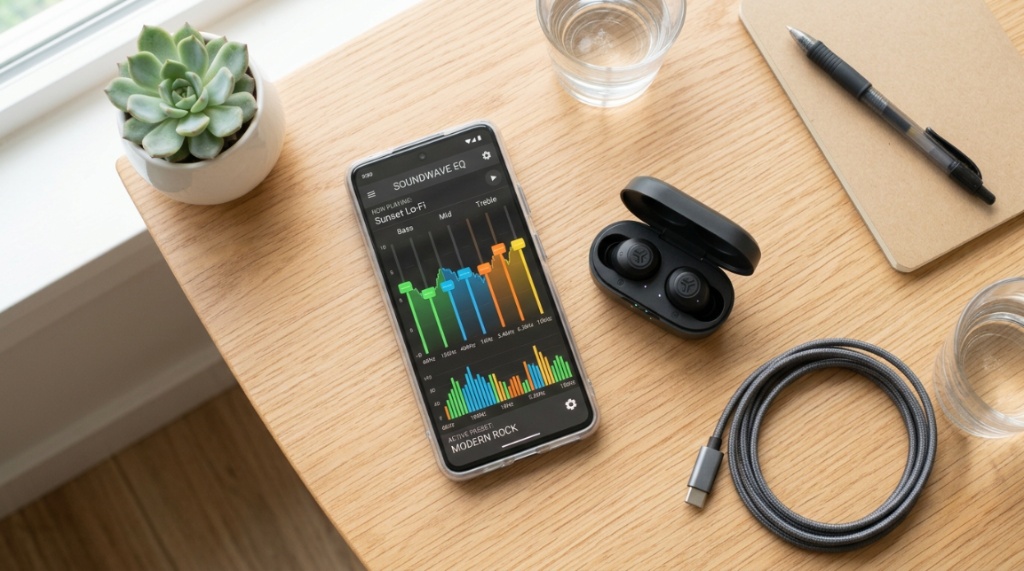
Yes. Physical enhancements (like foam tips and proper insertion) affect how sound enters your ear, solving mechanical resonance issues. Digital enhancements (EQ and DSP) alter the signal before it hits the driver. For best results, use both: first optimize the physical seal, then apply the digital corrections.
Adding Acoustic Dampening: The “Blu-Tack” Mod
Open your earbuds (if they have a mesh guard) and gently place a tiny piece (1mm) of Blu-Tack adhesive inside the nozzle. This absorbs internal reflecting waves that create treble peaks. It’s a risky mod but yields a 20% improvement in clarity for older models with brutal spikes. Only try if you’re handy.
Upgrading the Ear Tips: A List of Better Options
Besides foam, consider SpinFit CP100 (silicone, has a 3-axis rotation) or Whirlwind tips. These have a wider bore that doesn’t restrict high-frequency output. Many users in Philadelphia sell their old tips and buy these, noticing an immediate frequency response flattening.
How to Clean Titium Build-Up That Muffles Sound
Earwax on the mesh is a budget killer. Once a week, remove the tips and rub the mesh gently with a soft-bristled toothbrush. Do not use water. Then, use “Blu-Tack” to press against the mesh to pull embedded debris. This restores the original highs and image sharpness.
The Pros and Cons of Using a Bluetooth Amplifier Dongle
If your earbuds are wired but have detachable cables, you can plug them into a cheap Bluetooth receiver like the FiiO uBTR. This adds a more powerful amplifier than your phone’s built-in one, which reveals low-level details. The con is extra bulk, but the audio is cleaner and has less crosstalk.
When Should You Give Up and Buy Upgraded Earbuds?
If after applying all these tweaks the sound still distorts significantly at normal listening levels (over 70% volume), the drivers are physically damaged or too limited. This happens when the magnet is too weak and cannot control the diaphragm. At this point, your money is better used on a modern set.
Signs That Your Driver Is Clipping
Listen to a bass-heavy track with constant kick drums (e.g., Daft Punk). If you hear a “rattling” or “crackling” sound on the low end that isn’t in the recording, the driver is bottoming out. This is irreversible. EQ cannot fix a mechanical limit.
Warranty and Return Policies in PA Stores
If you bought locally in a retail store in PA (e.g., Best Buy), you have 15 days to return. However, if you bought them online, you likely have 30 days. Use this window to test the hacks above. If they work, keep them. If not, return and get a slightly more expensive model with aptX compatibility.
Evaluating the “Bass-Oriented” $50 Price Bracket
Between $40-$60, models like the Anker Soundcore P30i offer better build and stronger drivers. But even these need the tip upgrade to perform. Don’t jump price points until you’ve fixed the first pair; you’ll repeat the same mistakes unless you change your ear tip game.
How the PA Climate Affects Earwax Susceptibility
Pennsylvania’s humidity and heat increase moisture, which can interact with silicone tips and cause them to slide out. Foam tips absorb moisture and maintain friction. This is why recommending foam isn’t just about sound—it’s also about comfort in a Johnstown summer.
Frequently Asked Questions
Can I use a “Mastering” EQ preset on my Spotify app?
Yes, but you must turn off Spotify’s internal settings (Volume Level: Quiet) so it doesn’t add distortion. Use the phone EQ instead of the app EQ for more control, as the app offers limited bands and cannot fine-tune Q factors.
Are more expensive earbuds under $50 always better for sound?
Not necessarily. Price often reflects features (wireless charging, ANC) rather than audio quality. Some flagship budget models like the Moondrop Space Travel have exceptional drivers but poor tuning. Your tweaks can make a lesser-known model sound superior.
How long does it take to train the earbud’s drivers?
There is a myth called “burn-in.” Modern drivers do not change significantly after factory testing. If new earbuds sound harsh, it’s your ear becoming used to the signature, usually within 3 days. Do not play pink noise overnight; it may damage the delicate diaphragms.
Is listening at high volume a good way to judge Bass quality?
No. High volume induces physiological distortion (ear distortion). To judge bass, listen at a low volume and tap your foot. Good bass is felt as a pulse, not a constant drone. Use the volume tests mentioned to avoid hearing fatigue.
Can I use a dongle DAC with TWS earbuds?
No. TWS (True Wireless Stereo) earbuds have no input for a DAC because the driver is directly connected to the in-ear receiver. Only wired IEMs benefit from a DAC. This is a common misconception that might waste your money.
Which free app gives the best EQ for old Android phones?
“Wavelet” (free with in-app purchases) is the best. It offers 5-band GEQ, bass tuner, and headphone profiles. Another is “PowerAmp Equalizer,” which works system-wide without rooting. Both automatically start with your music app.
Do different Bluetooth codecs matter if I EQ afterwards?
Yes. EQ cannot restore audio data that was discarded during compression. If you have an aptX compatible phone and earbuds, ensure you’re using it. An EQ applied to high-quality source data yields better results than the same EQ applied to lossy SBC data.
Conclusion
Getting quality sound from your budget earbuds isn’t about spending more money; it’s about spending ten minutes on calibration. We’ve walked through the essential steps: creating a perfect physical seal, disabling gimmicky DSP, applying a surgical EQ cut, and understanding your audio source’s limitations. Each of these tasks costs nothing but dramatically changes your listening experience in Pennsylvania’s varying environments.
Start with the ear tip swap—that’s the 80% of the battle. Then, open your phone’s settings and disable any “surround” or “smart” effects. Apply a reduction at 250Hz to clean up mud, and a reduction at 7kHz to tame sibilance. Test with your favorite playlist, making adjustments to your volume level. You’ll be surprised, and proud, of what these cheap drivers can do.