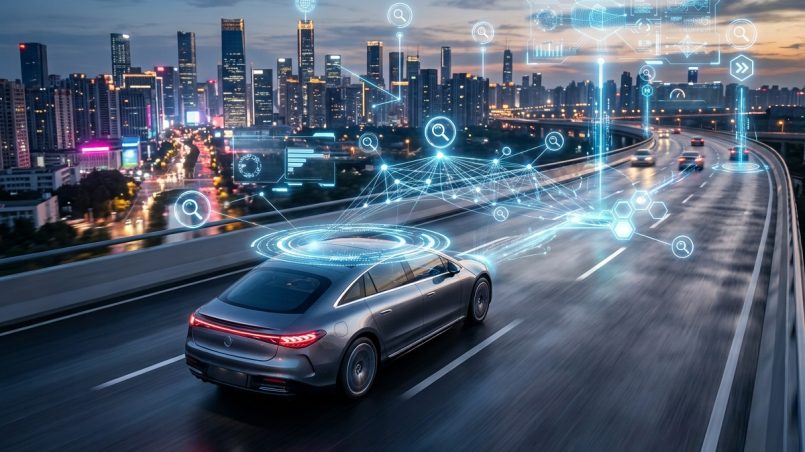
Connected vehicles are changing how customers perceive automotive technology. Modern vehicles can combine telematics, cloud computing, navigation, wireless communication, driver-assistance systems, remote diagnostics, and over-the-air software updates within a single digital environment.
As these technologies become more integrated, buyers increasingly need clear information about connectivity, software capabilities, data services, safety functions, and digital features before evaluating a vehicle. For automotive brands, this shift creates an opportunity to use artificial intelligence (AI) and search engine optimization (SEO) to answer technology-focused questions and reach buyers during different stages of the research journey.
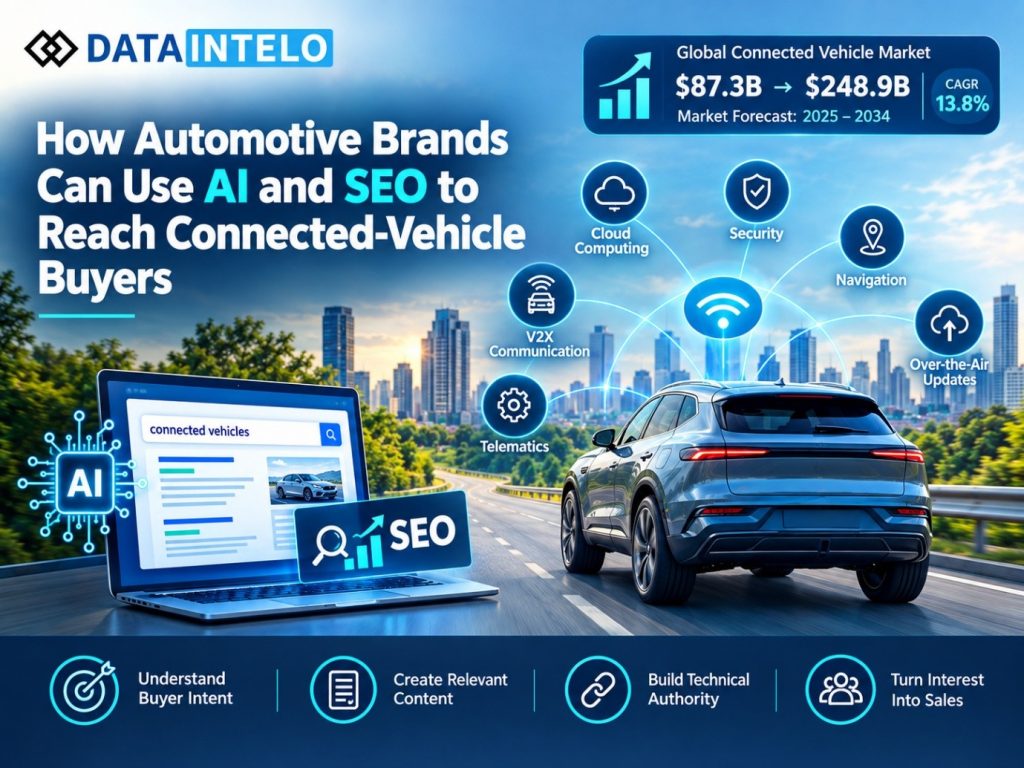
The expansion of connected-vehicle technology is also reflected in industry forecasts. According to Dataintelo, the global connected vehicles market was valued at $87.3 billion in 2025 and is projected to reach $248.9 billion by 2034, registering a 13.8% CAGR during the forecast period. This growth highlights the increasing importance of connected features and digital capabilities in automotive purchasing decisions, allowing brands to create SEO content that addresses buyers’ questions about vehicle connectivity, software, safety, and digital services.
AI Can Map the Connected-Vehicle Buyer Journey
It is rare to find someone who only thinks of vehicles when thinking of buying connected vehicles. They might want to know if the vehicle has vehicle-to-everything (V2X) capability, 5G capability, over-the-air (OTA) update capabilities and systems for advanced driver-assistance situations (ADAS), remote vehicle diagnostics, telematics systems, security capabilities, battery data such as the range of the battery, with the help of connected navigation before coming to a product page. According to the cited research work, connected vehicles can be categorized into five areas under connected vehicles technology. Safety services had a market share of 28.4% by 2025. AI is capable of dividing searches of hundreds of thousands of people into five categories: information, comparison, technicalities, ownership and purchase intention which would help the brands create respective content related to different stages of a customer journey.
AI can also identify relationships between search terms that traditional keyword lists may overlook. A consumer searching “what is V2X” may later investigate “V2V safety features” and then compare “connected SUV with remote diagnostics.” A brand can turn those 3 stages into an educational article, a technology comparison page, and a vehicle landing page. This structure helps search engines understand topical depth while giving buyers a logical path from basic information to product research.
Use AI to Build Technical SEO Content
AI-assisted research can help automotive teams organize 10–20 priority content themes around V2X, telematics, OTA software, cybersecurity, ADAS, fleet connectivity, and remote diagnostics. Connected vehicles also create substantial information flows. The referenced research estimates that an embedded connected vehicle can generate approximately 25 gigabytes of data per day. That figure creates opportunities for content explaining data management, predictive maintenance, fleet analytics, insurance telematics, and connected-service personalization.
AI should support research rather than replace engineering validation. A useful workflow can contain 3 stages: AI-assisted topic discovery, technical review, and editorial optimization. Automotive content may include measurements such as milliseconds, meters, gigabytes, software versions, sensor ranges, or communication intervals. Brands should therefore maintain technical fact sheets and require subject-matter review before publishing claims about vehicle capabilities.
SEO Should Reflect Real Vehicle Technology
Automotive SEO shows higher efficiency when pages take advantage of the terminology that drivers and engineers actually use. The Dataintelo report highlights V2V, V2I, V2P, V2N, and V2D as the key technology categories. In 2025, V2I accounted for 37.6% of the technology category, making infrastructure communication an important topic. Brands are able to create separate pages that focus on V2V alerts, V2I infrastructure communication, V2P communication with pedestrians, V2N network services, and V2D device integration.
The described structure can facilitate internal linking. The main connected vehicle technology page can link to 5 explanatory articles on V2X, while each explanatory article can link to related pages on particular makes, frequently asked questions, and service information. For instance, a V2I article can reference an article on traffic signal communication, and a V2D article can connect to a page about mobile app functionality. Instead of creating a single long page with all the terms, brands are able to create a complete structure for their cluster and provide a clear purpose for each topic.
Data Can Make Automotive Content More Credible
Data-driven content can distinguish automotive brands from pages built mainly around promotional language. The referenced research reports a 2025 global value of $87.3 billion, with Asia Pacific representing 35.8% of revenue and safety services accounting for 28.4%. Embedded connectivity represented 48.6% of the connectivity segment. These figures can support separate content themes around regional adoption, safety applications, and embedded technology.
Small, clearly labeled datasets can also make articles easier to understand. For example, marketers can present the global value, regional share, service share, and connectivity share in one compact table. A 35.8% regional share can support an Asia-focused SEO page, while a 48.6% embedded-connectivity share can support content about factory-integrated vehicle connectivity.
| Connected-vehicle metric | Reported figure |
| Global value, 2025 | $87.3 billion |
| Asia Pacific share | 35.8% |
| Safety services share | 28.4% |
| Embedded connectivity share | 48.6% |
| Daily vehicle data | 25 GB |
Build SEO Around V2X and Safety Searches
Safety is one of the strongest areas for connected-vehicle content because V2X can extend a vehicle’s awareness beyond conventional line-of-sight sensing. The U.S. Department of Transportation explains that connected-vehicle communications can exchange information within approximately 300 meters. It describes V2V and V2I communication as radio-based, omnidirectional systems that can provide information about other road users and potential hazards.
Government testing also demonstrates the technical complexity behind V2X. A U.S. Department of Transportation LTE-V2X test plan used 250-plus onboard units and 10-plus roadside units in controlled scenarios. The test plan examined payloads of 365 bytes for V2V and 1,400 bytes for infrastructure-to-vehicle communication, while transmit-time intervals included 100, 300, and 600 milliseconds. These numbers provide strong technical material for SEO pages explaining latency, communication density, payload size, and network performance.
Use AI for Personalization, Not Hype
A useful editorial calendar can schedule 4 technical explainers, 4 comparison pages, and 4 vehicle-specific articles each quarter, creating 12 measurable assets without sacrificing technical depth or source quality. This cadence gives AI useful patterns faster.
AI can help automotive brands create different content journeys for different buyer groups. The referenced research reports that passenger cars represented 68.2% of the connected-vehicle segment in 2025, while commercial vehicles accounted for 31.8%. That split provides a measurable basis for separating consumer and fleet SEO strategies.
A passenger-car content pathway can emphasize navigation, remote access, infotainment, safety alerts, and software updates. A fleet pathway can focus on telematics, diagnostics, route optimization, vehicle utilization, and maintenance. Marketers can begin with 2 major audience paths and then subdivide them into 5–10 intent clusters based on search behavior. AI can monitor engagement and conversion signals without changing the underlying technical facts.
Strengthen Trust With Technical Transparency
Connected-vehicle SEO should explain limitations as clearly as benefits. Brands should identify whether a feature depends on cellular coverage, compatible infrastructure, a subscription, a particular software version, or a specific vehicle configuration. The research identifies cellular communication as 72.3% of the communication segment in 2025, illustrating why connectivity infrastructure is an important subject for educational content.
Safety claims also require careful sourcing. NHTSA’s Partnership for Analytics Research in Traffic Safety analyzed approximately 98 million vehicles covering 168 models from model years 2015–2023 and more than 21.1 million police-reported crashes. Its latest study reported a 49% reduction in front-to-rear crashes associated with automatic emergency braking across model years 2015–2023. Automotive marketers can use such government evidence to explain the broader context of ADAS while avoiding unsupported claims about individual vehicle systems.
Measure Search Performance as a Technology Funnel
Automotive SEO should be measured beyond rankings. A 12-month program can track impressions, click-through rate, organic sessions, engagement, brochure downloads, configuration starts, test-drive requests, and qualified leads. AI can compare performance across 10–20 technology clusters and identify which subjects attract useful traffic.
For example, a V2X page may generate strong impressions but few vehicle-page visits. The brand could then add 3–5 relevant internal links to models, FAQs, or technology specifications. If an OTA article generates strong engagement but weak conversions, marketers can add compatibility details, software-update explanations, ownership questions, and clearer product pathways.
Connecting Search Strategy With Vehicle Technology
The opportunity is to make complex automotive technology easier to discover, understand, and evaluate. Connected vehicles can generate approximately 25 gigabytes of data daily, while embedded connectivity represented 48.6% of the connectivity segment in the referenced research. At the same time, V2X consists of five types of communication, leading to a vast range of possibilities for search-related material.
Car manufacturers may begin with 10-20 crucial topics and develop them into FAQs, compare-and-contrast materials, glossaries, etc. Some statistics indicate that by the year 2025, safety services will account for 28.4% of this industry, while Asia Pacific will have the biggest share of revenue—35.8%. Although these numbers can be used in content development planning, they cannot replace customer analysis and the validity of technical aspects.
The core of an efficient AI-driven SEO approach is a connection between what consumers want to know and what vehicles have to offer. AI allows highlighting recurring questions, categorizing types of queries, structuring content groups, and determining effectiveness. SEO can connect those answers through internal links, structured pages, and useful metadata. When engineering evidence, government research, and clearly attributed industry data are combined, automotive brands can give connected-vehicle buyers more useful information before they reach a dealer or configure a vehicle.
Reference: https://dataintelo.com/report/global-connected-vehicle-market
Author: This Article is written by Ashish Kolte is a Marketing Manager at Dataintelo with expertise in marketing, market intelligence, and business strategy. He combines marketing insights with industry research to help organizations understand market dynamics, identify growth opportunities, and make data-driven decisions. His areas of interest include emerging technologies, artificial intelligence, healthcare, industrial markets, and global business trends. Through his writing, Ashish shares research-backed perspectives on evolving industries and strategic market developments.