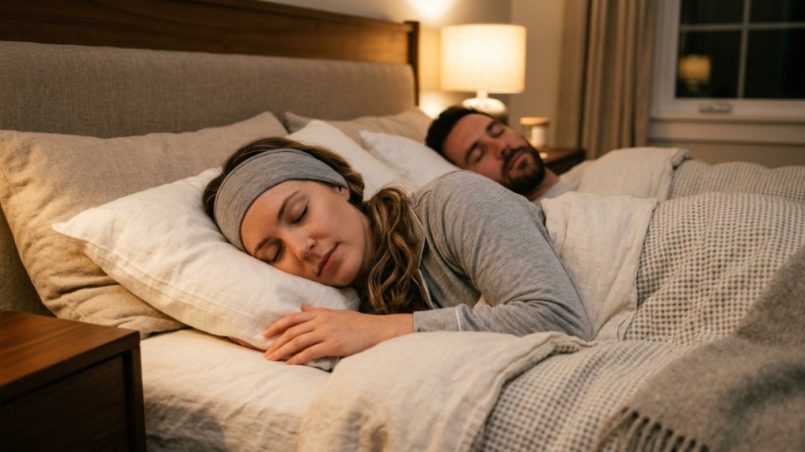
Sharing a bed adds constraints that solo sleepers never consider: your sleep headphones can’t leak sound that wakes your partner, can’t have protruding components that poke them during cuddle shifts, and can’t create a visible/audible barrier that signals emotional withdrawal in the relationship. Headphones for snoring partner situations need to solve YOUR noise problem without creating a NEW problem for the person sleeping 18 inches away. Sleep-friendly headphones for shared beds balance personal noise isolation with couple-compatible design — discrete enough to not disrupt your partner’s sleep or your physical connection.
Sleep-friendly headphones for bed-sharing are overnight audio devices that provide personal noise masking or content delivery without leaking sound to a partner, creating physical interference during shared sleeping, or requiring removal for normal couple interactions (brief conversation, contact, rolling toward each other). The “shared bed” constraint eliminates many sleep headphone options that work perfectly for solo sleepers.
This guide addresses the specific challenges of bed-sharing that most sleep headphone reviews ignore — because most reviewers test alone, missing the partner-impact dimension entirely.
What Constraints Does Bed-Sharing Add to Sleep Headphone Selection?
Bed-sharing adds four constraints: zero sound leakage (partner can’t hear your audio), minimal physical profile (no hard edges poking during contact), discrete visual/emotional presence (not creating a “barrier” feeling), and ability to hear your partner if they need you (emergencies, conversation, alarm acknowledgment).
Shared-bed constraints explained:
- Sound leakage prohibition: If your partner can hear your white noise or sleep audio, it becomes THEIR sleep disruptor. Sealed in-ear designs leak near-zero audio. Headband speakers and bone conduction leak slightly — potentially audible in shared pillow proximity.
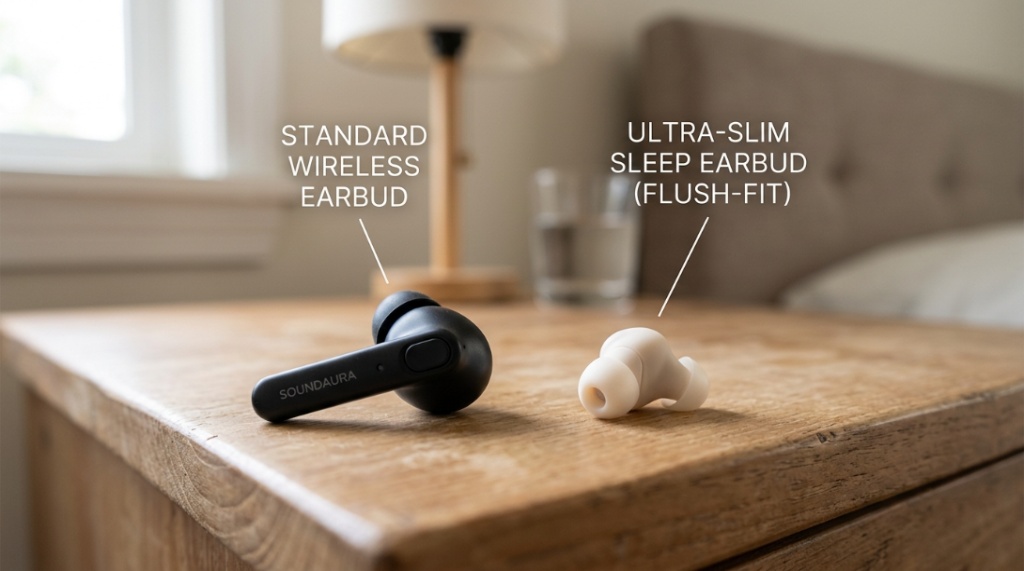
- Physical compatibility: When your partner rolls toward you, rests against your head, or you shift positions during sleep, protruding headphone components create uncomfortable contact for both parties. Ultra-flat designs prevent this.
- Emotional/relational sensitivity: Some partners feel rejected when their bedmate puts on visible headphones — interpreting it as withdrawal. Discrete options (tiny earbuds invisible from partner’s perspective, or headbands that look like sleep masks) reduce this perception.
- Partial awareness maintenance: You may need to hear if your partner speaks (nightmare, question, emergency) or if a child calls. Complete noise isolation without any awareness pathway creates a safety/relational concern for some couples.
| Constraint | Best Product Type | Worst Product Type |
|---|---|---|
| Zero sound leakage | Sealed in-ear sleep earbuds | Headband speakers, bone conduction |
| Minimal physical profile | Sub-6mm sleep earbuds or thin headband | Over-ear headphones, standard earbuds with stems |
| Discrete/non-barrier | Invisible tiny earbuds, sleep-mask headband | Large visible over-ear headphones |
| Partner awareness | One-ear-only use or transparency mode | Full dual-ear sealed isolation |
Which Sleep Headphones Leak Zero Sound to a Bed Partner?
Sealed in-ear sleep earbuds (Bose Sleepbuds II, QuietOn 3, Amazfit ZenBuds) produce zero detectable sound leakage at appropriate sleep volumes. At 50–60% volume with sealed ear tips, a partner sleeping on the adjacent pillow cannot detect any audio — even in a completely silent room.
Leakage testing by product type:
- Sealed sleep earbuds (zero leakage): Audio is delivered directly into a sealed ear canal. At sleep-appropriate volumes, sound energy is entirely contained within the ear. Your partner cannot hear anything even with their ear against your pillow.
- Sleep headband speakers (minimal-to-slight leakage): Flat speakers sit over ears within fabric. At low volumes (30–40%), leakage is undetectable. At moderate volumes (50–60%), a partner with their head on the same pillow MAY detect faint audio in a silent room. Acceptable for most couples.
- Bone conduction sleep devices (slight leakage): Vibration-based audio inherently produces some air-radiated sound. At sleep volumes, leakage is minimal but present. Not ideal if your partner is an extremely light sleeper.
For couples where the non-wearing partner is a light sleeper, sealed in-ear options are the only guaranteed zero-leakage solution. Headband speakers work for partners with normal sleep depth who won’t be awakened by faint audio frequencies.
How Do You Maintain Physical Intimacy While Wearing Sleep Headphones?
Choose headphones that allow comfortable close-proximity sleeping: tiny earbuds that don’t protrude beyond the ear’s natural contour, or thin headbands that double as comfortable sleep masks during spooning and close contact. Avoid anything with rigid external components that create barriers to natural sleeping proximity.
Physical intimacy compatibility by product type:
- Ultra-thin sleep earbuds (most compatible): Sub-6mm profile sits flush within the ear canal. No external protrusion. Partner can rest their head against yours, you can spoon freely, and no component creates discomfort during contact. Essentially invisible to physical interaction.
- Thin fabric headband (good compatibility): Soft fabric band feels like a sleep mask during contact. Partners can rest against it without discomfort. No hard edges. The band itself becomes a familiar sleep accessory that both parties adapt to quickly.
- Standard earbuds with stems (poor compatibility): Stem protrudes from ear creating a poking hazard during close proximity. Partner resting their face near your ear encounters hard plastic. Creates physical barrier to natural closeness.
- Over-ear anything (incompatible): Bulky cups make face-to-face proximity impossible and create barriers to spooning. Physically incompatible with shared-bed couple sleeping positions.
The best sleep-friendly headphones guide includes partner-compatibility ratings tested by actual couples in shared sleeping arrangements.
Should You Wear Sleep Headphones in Both Ears or Just One?
For snoring-blocking purposes, both ears is significantly more effective (80–95% reduction vs. 50–60% with one ear). For maintaining partner awareness, one ear provides noise masking on the partner-facing side while keeping the other ear open for hearing conversation or children. Choose based on whether noise blocking or awareness matters more.
One-ear vs. two-ear strategy:
- Both ears (maximum noise blocking): Best for heavy snoring situations, light sleepers who wake from any noise, or sleepers who need total masking to fall asleep. Trade-off: can’t hear partner, children, or alarms without vibration/visual alternatives.
- One ear — partner-facing side (compromise): Blocks snoring from the primary source direction while leaving one ear open for awareness. Provides 50–60% snoring reduction. Adequate for moderate snoring when you want to remain responsive to your partner.
- Both ears with transparency mode (tech compromise): Some earbuds allow one-tap activation of environmental passthrough — blocks snoring by default but lets you hear when needed with a quick touch. Requires a specific feature set not all sleep earbuds offer.
How Do You Discuss Sleep Headphones With a Sensitive Partner?
Frame it as a positive solution (you’re improving YOUR sleep quality, not criticizing their snoring), offer reciprocal solutions (have they tried positional sleep aids?), and choose discrete products that don’t create visible emotional barriers. The conversation matters as much as the product choice for long-term relationship satisfaction.
Communication approach:
- Frame positively: “I want to try sleep headphones so I can sleep deeper — I think it’ll help my energy” rather than “Your snoring is keeping me awake and I need headphones to block you out.”
- Normalize the solution: “Lots of couples use these — it’s like having a sleep mask for sound” reduces the stigma of it feeling unusual or rejecting.
- Offer partnership: “I’ll try sleep headphones for my side, and maybe we can try a new pillow/position for your side?” positions it as a team problem being solved from both directions.
- Address the unspoken concern: If your partner seems hurt, address it directly: “This isn’t about not wanting to be near you — it’s about both of us sleeping better so we’re happier together during the day.”
- Start discrete: Tiny invisible earbuds create less “barrier” perception than visible headbands. Once the positive sleep results are apparent to both parties, the product acceptance increases naturally.
What Happens If Your Partner’s Alarm Goes Off and You Can’t Hear It?
Use vibration-based alarm solutions (smartwatch vibration alarm, phone under pillow on vibrate, or bed-shaker alarms) as backup when wearing sealed sleep headphones. Alternatively, some sleep headphones include built-in alarms that wake only you through the headphones while your partner’s alarm functions normally for them.
Alarm solutions for headphone-wearing sleepers:
- Smartwatch vibration alarm: Wrist vibration wakes you silently without requiring hearing. Apple Watch, Fitbit, and Garmin all offer vibration-only alarms. Most reliable backup for sealed-earbud wearers.
- Phone under pillow (vibrate mode): Physical vibration transmits through the pillow to your head — felt even with sealed earbuds. Simple, free solution using existing phone alarm on vibrate-only mode.
- Built-in headphone alarm: Bose Sleepbuds II and some sleep headband models include alarm features that play directly into your ears. Wakes you without waking partner. Time-specific and gentle escalation available.
- Bed shaker alarm: Device placed under your pillow side that vibrates powerfully at set times. Designed for deaf/hard-of-hearing users. Works perfectly for sealed-headphone sleepers. $25–$40 standalone devices.
Are There Sleep Headphones Designed Specifically for Couples?
Several products address the shared-bed scenario specifically: Bose Sleepbuds II (designed with partner privacy in mind), Kokoon Nightbuds (built-in sleep tracking and alarm for individual use without partner disruption), and SleepPhones (headband design promoted for bed-sharing comfort). All three prioritize the couple-dynamic constraints alongside sleep audio delivery.
- Bose Sleepbuds II ($249): Specifically designed for shared-bed scenarios. Ultra-tiny sealed design. Zero leakage. Built-in masking sounds curated for snoring environments. Alarm feature wakes only you. The premium couple-focused option.
- Kokoon Nightbuds ($179): Designed for side sleepers sharing beds. Flat flexible body. Sleep tracking built in. App-based alarm system. Audio fading as you fall asleep (detected via EEG sensors). Technology-forward couple option.
- SleepPhones ($40–$100): Headband designed for physical compatibility in shared beds. Soft fabric feels like a sleep mask to partner during contact. Machine-washable. Most affordable couple-friendly option. Slight leakage at higher volumes — adequate for most partnerships.
- QuietOn 3 ($259): ANC-focused sleep earbuds designed for snoring blocking. Ultra-small sealed design. Excellent passive + active isolation. No audio streaming — purely noise cancellation. Best for couples where blocking snoring without adding masking audio is preferred.
Conclusion
Choosing headphones for sleeping when you share a bed requires balancing your noise-blocking needs against your partner’s comfort, your physical intimacy, and your relationship dynamics. Sealed ultra-thin sleep earbuds (Bose Sleepbuds II, QuietOn 3) provide maximum snoring blocking with zero partner impact — no leakage, no physical intrusion, no visible barrier. Sleep headbands offer better comfort with slight leakage trade-off that works for most partnerships. Communicate positively about the solution, address emotional concerns directly, and choose the most discrete option that meets your noise-blocking minimum. Both sleepers deserve quality rest — the right headphones make this possible without compromise.
Explore couple-tested sleep headphone options with partner-impact ratings at the sleep-friendly headphones guide reviewed from both wearer AND partner perspective.
How has snoring affected your relationship sleep dynamics? Share your experience in the comments — solutions that worked for real couples provide the most valuable guidance for others facing the same challenge.
If your partner snores loudly, passive noise isolation might not cut it. You will want to look for active noise-canceling (ANC) models that can block out heavy low-frequency sounds. While premium sleep gear can get pricey, you don’t always have to break the bank for top-tier audio tracking; for instance, you can find affordable Bose QuietComfort headphones in New York without overpaying if you know where to look. Balancing comfort with robust noise cancellation is the ultimate secret to sharing a bed successfully.
Frequently Asked Questions
Will my partner know I’m wearing sleep headphones?
With ultra-thin sealed earbuds (Bose Sleepbuds, QuietOn), your partner likely won’t notice visually in dark bedroom conditions. They’re invisible from the outside and sit flush with the ear canal. Sleep headbands are visible but look like sleep masks — normal bedroom accessories. Only standard earbuds with protruding stems are obviously visible.
Can sleep headphones cause relationship problems?
Only if introduced without communication. Partners who feel excluded or criticized may react negatively. The product itself doesn’t cause relationship issues — the framing and communication around introducing it does. Presented as a personal sleep quality improvement (rather than criticism of the partner’s snoring), most couples adapt positively within a week.
What if my partner also wants sleep headphones?
Both partners wearing sealed earbuds eliminates ALL leakage concerns and creates a mutually quiet sleep environment. Some couples both use sleep headphones — one for snoring blocking, the other for relaxation audio. The only consideration: ensure at least one person has awareness capability (smart alarm, baby monitor connection) for household emergencies.
Do sleep headphones affect sleep quality for the wearer?
High-quality sleep headphones improve measured sleep quality for noise-affected sleepers — reducing wake-after-sleep-onset and increasing deep sleep duration. The improvement is significant (15–30 minutes more deep sleep per night in studies) for sleepers previously disrupted by partner noise. Poorly fitting headphones that cause discomfort can worsen sleep quality — proper fit testing prevents this.
Can I still hear my baby with sleep headphones in?
With sealed dual-ear headphones at masking volume: probably not reliably. Solutions: use one earbud only (baby monitor on the open ear), pair a separate baby monitor with vibration alert on your nightstand, or choose headphones with transparency/passthrough mode that can be activated by external sound threshold (baby crying exceeds snoring volume, triggering passthrough).
How do I charge sleep headphones without disrupting my nighttime routine?
Charge during your evening routine (dinner through pre-bed relaxation) rather than overnight. Most sleep headphones reach full charge in 1–2 hours — plug in when you get home, they’re ready by bedtime. Alternatively, products with multi-night battery (Bose Sleepbuds: 3 nights per charge) require charging only every few days rather than nightly.